
As dawn breaks over Luxor, thousands of ancient columns rise from the desert like a stone forest. This is Karnak Temple, once called “The Most Select of Places,” where gods were worshipped, priests ruled, and pharaohs built monuments to eternity.
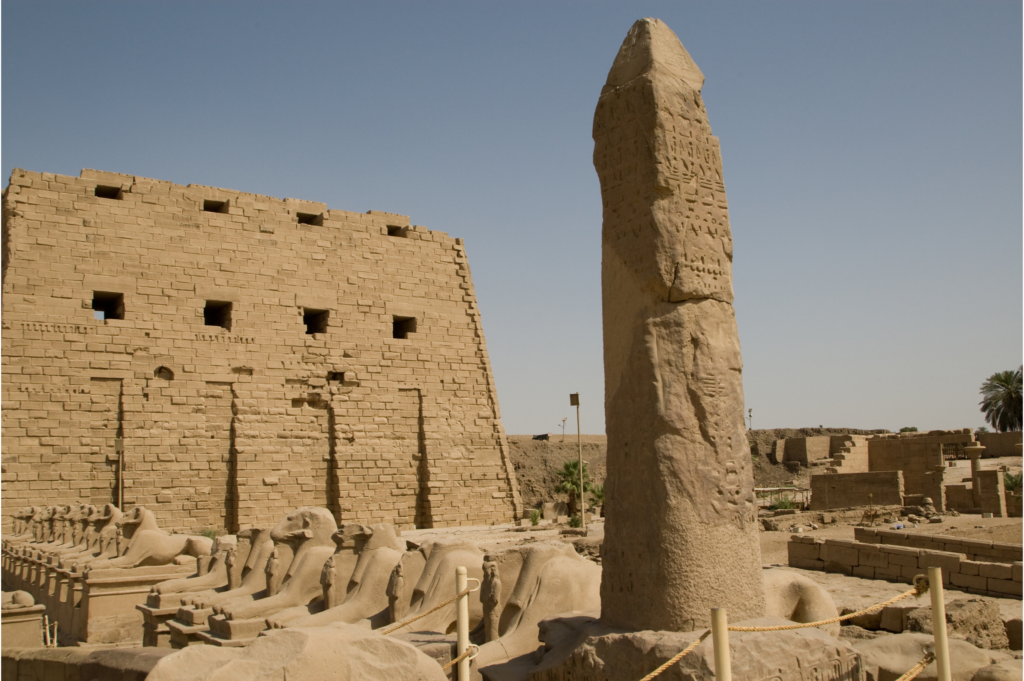
On the East Bank of the Nile, north of Luxor Temple, lies Karnak Temple, the largest religious complex ever built in the ancient world.
This is not just a temple.
It is a sacred city carved in stone, built by generations of Egypt’s greatest rulers.
For more than 2,000 years, pharaohs expanded Karnak to honor the gods, display their power, and secure immortality. Today, walking through Karnak feels like stepping into the heart of ancient Egypt.
What Is Karnak Temple?
Karnak Temple is a vast complex of temples, chapels, pylons, obelisks, and sacred lakes dedicated mainly to Amun-Ra, Mut, and Khonsu, known as the Theban Triad.
Ancient Egyptians believed Karnak was the center of divine power. It was the spiritual capital of Thebes, the city of gods and kings.
The Meaning of Karnak: Ipet-Sut
The Meaning of Karnak: Ipet-Sut
In ancient times, Karnak was called Ipet-Sut, meaning “The Most Select of Places.”
This name reflected its sacred status. It was considered the holiest place in Egypt, where the gods lived on earth.
For Egyptians, Karnak was not just architecture. It was a living universe, where the cosmos, nature, and divine order met.
Where Is Karnak Located?
Karnak Temples are located on the East Bank of Luxor, about three kilometers north of Luxor Temple.
The two temples were connected by the famous Avenue of Sphinxes, a sacred road used during religious festivals.
This processional route symbolized the journey of the gods from Karnak to Luxor Temple during the Opet Festival.
History of Karnak Temples
Origins in the Middle Kingdom
Construction began around 2000 BC during the Middle Kingdom. Early temples were modest, but the site quickly grew in importance as Thebes became Egypt’s capital.
The New Kingdom Expansion
The New Kingdom transformed Karnak into a monumental religious city. Pharaohs built grand halls, obelisks, and pylons to honor Amun and glorify their reign.
Famous rulers who built at Karnak include
- Hatshepsut, who erected massive obelisks
- Thutmose III, the warrior pharaoh
- Amenhotep III, the builder king
- Seti I and Ramses II, who expanded the Hypostyle Hall
Greco-Roman Period
Later, Ptolemaic and Roman rulers added chapels and temples, continuing Karnak’s role as a sacred center even after the pharaohs.
The Precincts of Karnak
Karnak is divided into several sacred precincts:
Precinct of Amun-Ra
The largest and most important area. It includes the Great Hypostyle Hall, pylons, and sanctuaries.
Precinct of Mut
Dedicated to the goddess Mut, wife of Amun. It includes a sacred lake and temples.
Precinct of Montu
Dedicated to Montu, the war god, located in the northern part of Karnak.
Temple of Aten
Built by Akhenaten during his religious revolution, dedicated to the sun disk Aten.
The Great Hypostyle Hall: A Forest of Stone
One of the most breathtaking parts of Karnak is the Great Hypostyle Hall.
It contains 134 massive sandstone columns, some reaching more than 20 meters high.
Walking through this hall feels like walking through a stone forest.
The columns are carved with scenes of battles, rituals, and offerings to the gods.
This hall is considered one of the greatest architectural achievements of ancient Egypt.
Obelisks, Pylons, and Sacred Architecture
Obelisks
Karnak is famous for towering obelisks, especially those built by Queen Hatshepsut. One of her obelisks stands nearly 30 meters tall and weighs over 300 tons, symbolizing the connection between the earth and the sun god.
Pylons and Courts
Massive pylons marked entrances to sacred spaces. Each courtyard represented a step closer to the divine sanctuary.
Chapels and Shrines
Numerous chapels dedicated to different gods and royal cults made Karnak a complex religious city.
The Sacred Lake
The Sacred Lake at Karnak was used by priests for purification rituals before ceremonies.
It also symbolized the primeval waters of creation, from which the universe was born.
Karnak and the Opet Festival
Karnak played a central role in the Opet Festival, one of ancient Egypt’s most important celebrations.
During the festival, statues of Amun, Mut, and Khonsu traveled from Karnak to Luxor Temple along the Avenue of Sphinxes.
This journey symbolized the renewal of the pharaoh’s divine power.
It was a time of music, dancing, feasting, and national celebration.
Religious and Political Importance
Karnak was not only religious—it was political.
The priests of Amun controlled vast lands and wealth. They influenced kings and sometimes rivaled royal power.
The temple complex also symbolized the universe.
- Pylons represented mountains
- Columns represented papyrus marshes
- The sacred lake represented the waters of creation
Karnak was a cosmic model of the world.
Karnak Temple Sound and Light Show
Today, visitors can enjoy the Karnak Sound and Light Show, which tells the history of Thebes with lights, music, and narration.
It is one of the most popular evening activities in Luxor.
Why Karnak Temples Matter Today
The Karnak Temples are a symbol of Egyptian civilization and human ambition.
They show how ancient Egyptians understood religion, architecture, power, and the universe.
Today, Karnak is one of the largest archaeological sites in the world and a highlight of any Egypt journey.
Walking through its columns, you feel small—and connected to eternity.